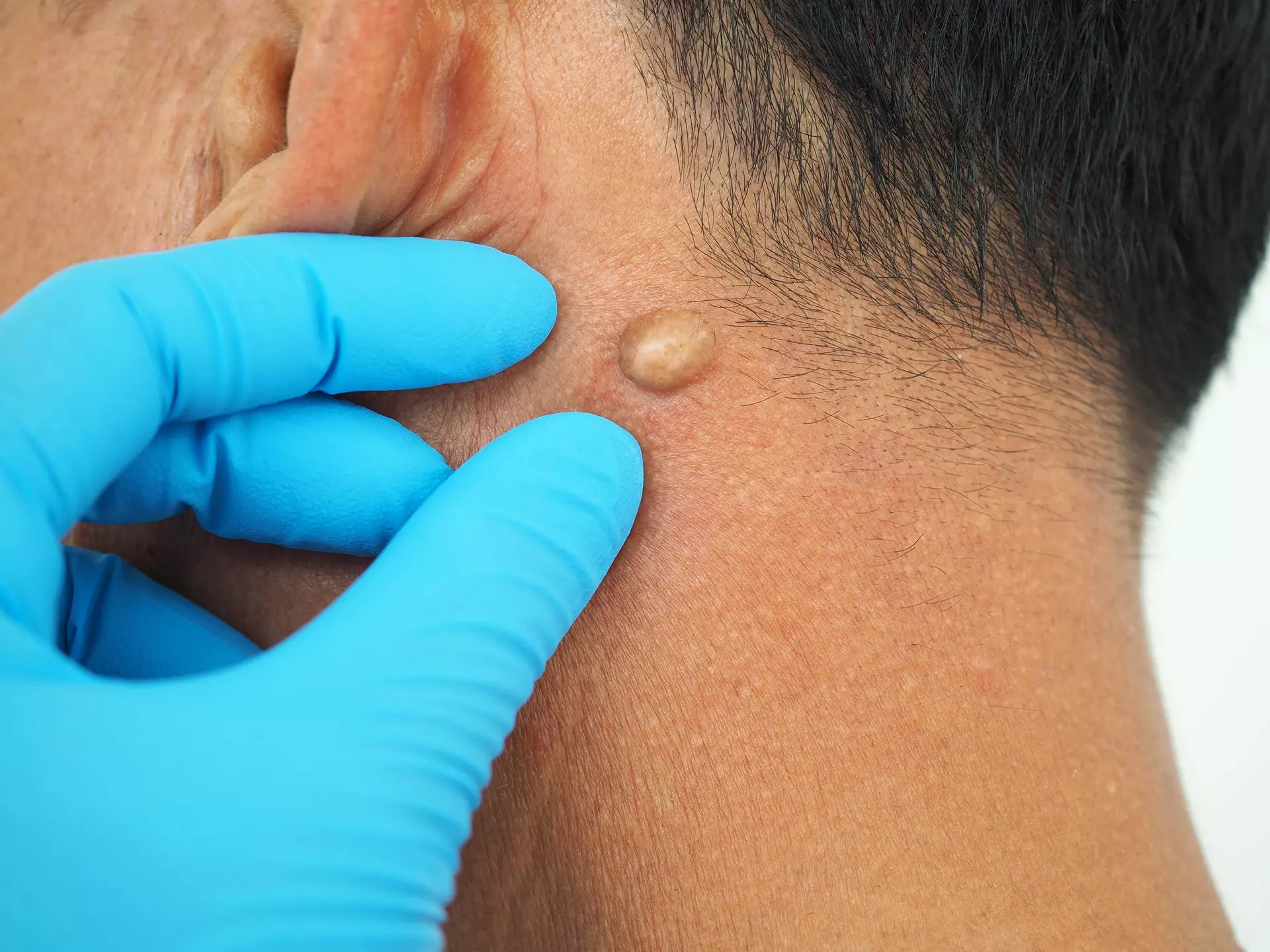
Cysts and lipomas are among the most common benign growths we remove. Neither is medically dangerous in the typical case, but both can be uncomfortable, cosmetically bothersome, grow over time, and in the case of cysts, become infected and inflamed at unpredictable intervals. The question isn’t usually whether to remove them — it’s when.
Epidermoid cysts
Epidermoid cysts (commonly but inaccurately called sebaceous cysts) form when keratin becomes trapped beneath the skin surface in a sac lined by epithelial cells. They appear as firm, dome-shaped bumps under the skin, often with a central punctum visible on the surface, most common on the face, scalp, neck, and trunk.
Most are asymptomatic and grow only slowly. The decision to remove them is often elective — the patient prefers not to have it there, it’s in a location where pressure causes irritation, or it’s been enlarging. Removal is a minor in-office procedure under local anesthesia: a small incision, removal of the cyst sac intact if possible, and closure. Removing the cyst without rupturing the sac is cleaner and significantly reduces recurrence.
When a cyst becomes infected or inflamed — warm, red, tender, and sometimes draining — it’s not the right time for definitive surgical removal. The inflamed tissue makes clean dissection of the sac much more difficult and increases recurrence. The acute episode is best managed with intralesional steroid injection, incision and drainage if a frank abscess has formed, and oral antibiotics when appropriate. Definitive excision is then planned once the inflammation has fully resolved.
Lipomas
Lipomas are benign tumors of fat tissue that develop in the subcutaneous layer just beneath the skin. They are the most common soft tissue tumor in adults, appearing as soft, movable, usually painless lumps that grow slowly over years. Most common on the trunk, shoulders, upper arms, and thighs.
Most lipomas don’t require removal. We remove them when they’re growing, when they’re symptomatic (pressing on a nerve or vessel, causing discomfort with pressure or movement), when the diagnosis is uncertain, or when the patient prefers not to have them. Removal is done under local anesthesia in our office. A small incision is made over the lipoma, and the fatty lobule is dissected free from the surrounding tissue. Closure is in layers.
Frequently asked questions
How do I know if it’s a cyst or a lipoma?
Cysts are usually firmer and more discrete, often with a visible punctum, and may feel fluid-filled when pressed. Lipomas are softer, doughy, and more diffuse. The clinical distinction is usually clear, but when uncertain — particularly for deeper or unusual lesions — imaging or pathological examination of the removed specimen provides certainty.
Can a cyst be drained rather than removed?
Draining a cyst addresses the immediate symptoms but leaves the sac behind. Without the sac there’s nothing to drain; with the sac intact it will refill. Definitive removal of the sac is the only way to resolve the cyst permanently. For an actively inflamed cyst where surgery isn’t appropriate at that moment, injection and drainage manage the acute episode, with removal planned once the inflammation settles.
Will there be a scar?
Both procedures leave a small linear scar at the incision site. We plan the incision along natural skin tension lines where possible and close in layers to minimize the cosmetic result. For most patients and most locations, the scar is small and fades well over 12 to 18 months.
Can cysts or lipomas become cancerous?
Epidermoid cysts are benign and don’t transform malignantly. Lipomas are overwhelmingly benign — malignant transformation is exceptionally rare and occurs almost exclusively in large, deep lipomas rather than the typical subcutaneous variety. If a lipoma is large, deep, firm, or growing rapidly, imaging before removal is appropriate.